

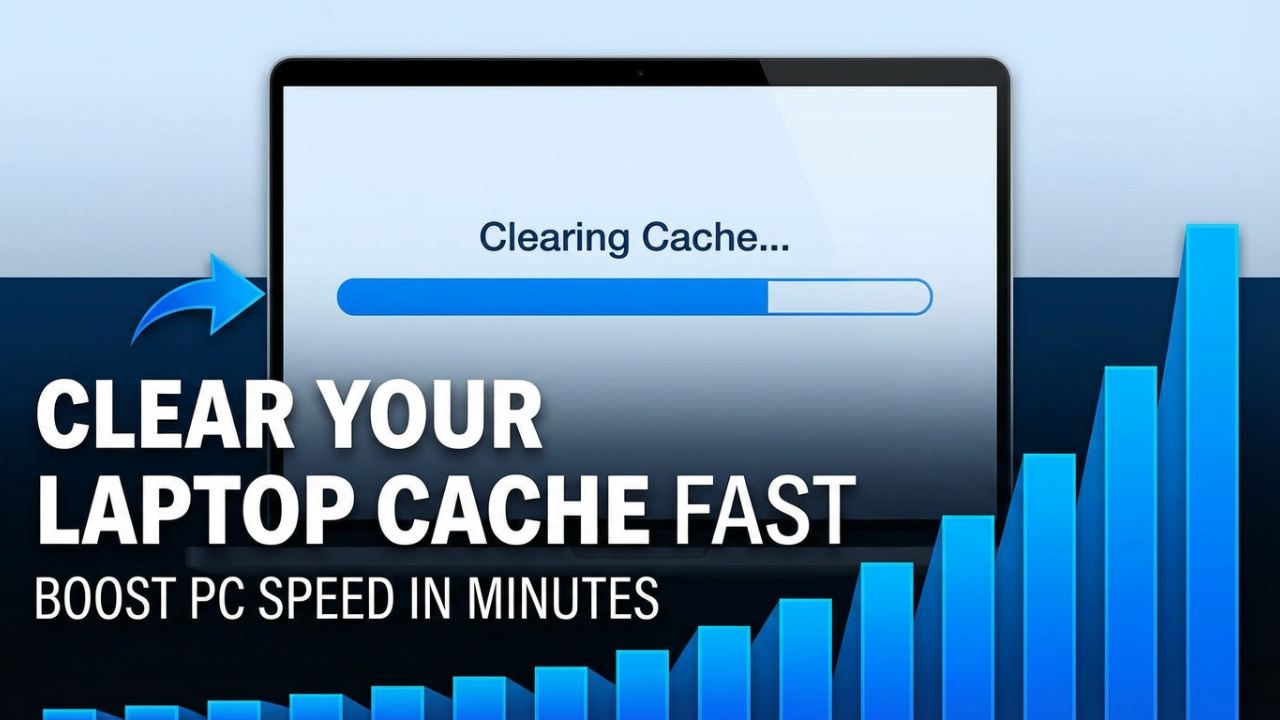
Is your laptop starting to feel sluggish? Cache on your laptop! Are websites loading weirdly, or are you seeing strange errors pop up? It’s a frustrating problem, and often, the cause feels like a total mystery. You might worry it’s a sign of a failing hard drive or just old age, but sometimes, the fix is much simpler and completely free.
While many things can slow down a PC, one common factor you can control is a cluttered cache. In this video, I’m going to show you how to clean out the two main types—the browser cache and the system cache—to get your laptop running better. This is your guide to safely clearing out the digital junk that accumulates over time. It’s a low-risk process that can make a real difference in reclaiming disk space and fixing errors, and it might even make your system feel a bit snappier. And don’t worry, we’re only targeting temporary files; this process won’t delete your personal files, photos, or documents.
Section 1: Understanding Cache – The “Why” Before the “How”
Before we delete anything, let’s quickly talk about what cache is. Think of it as a storage spot for temporary files that your computer uses to speed things up. It’s like a chef keeping common ingredients prepped at their station instead of running to the storeroom every time. That’s what cache does—it keeps frequently used data close by so it doesn’t have to be fetched from your hard drive or the internet over and over.
This is great for performance, at first. But if that prep station never gets cleaned, old ingredients pile up, get in the way, and can even cause problems. When your computer’s cache gets too full or contains outdated information, the very thing designed to speed it up can start to cause issues. We’ll focus on two main types.
First is the **System Cache**. These are temporary files created by the Windows operating system and your applications. Think of installer files, error logs, and other bits of data that apps create to launch faster. Windows is supposed to clean up after itself, but it’s not always perfect. Over time, these leftovers can accumulate, taking up gigabytes of space and sometimes contributing to system slowdowns.
The second type is the **Browser Cache**. Every time you visit a website, your browser saves pieces of it—the logo, images, and style sheets. This makes your next visit faster because it can load those saved pieces from your computer instead of re-downloading them. The problem is when a website updates. Your browser might load the old, cached version of an image or button, which can make the site look broken. Plus, this cache can grow to a massive size, eating up valuable storage.
So, clearing the system cache helps free up disk space and can help the OS run more smoothly, while clearing the browser cache is great for fixing website loading issues. Now that you know the “why,” let’s get into the “how.”

International Computer Manufacturing Company
Section 2: Clearing the System Cache – The Deep Clean
Alright, let’s start with the system-level cleaning. Remember, these steps are generally safe, and we won’t be touching your personal data.
Step 1: The User Temp Folder
First up is the temporary folder specific to your user account. This is where the applications you use—your photo editor, games, and other programs—store their temporary files. It’s often one of the biggest sources of clutter.
The process is simple. First, open the “Run” dialog box by pressing the **Windows key** and the **R key** at the same time.
In the box that pops up, type `%temp%`—that’s a percentage sign, the word `temp`, and another percentage sign. Then, press Enter.
A folder will open, likely filled with tons of files and other folders. These are the temporary files created by your programs. To select everything, press **Ctrl + A** on your keyboard.
With everything highlighted, press the **Delete** key.
You will almost certainly see a pop-up that says “File In Use,” meaning a program is currently using that file. This is totally normal. Near the bottom of the pop-up, check the box that says “Do this for all current items,” and then click the “Skip” button. Windows will delete everything else, leaving only the few files that are actively needed.
Step 2: The Windows Temp Folder (C:\Windows\Temp)
Our next stop is the temporary folder that Windows itself uses for system processes, like updates and installations.
This time, instead of using the Run box, open your File Explorer. Click on “This PC,” then double-click your `(C:)` drive. Inside, find and open the `Windows` folder. Now, scroll down and double-click the `Temp` folder.
You’ll likely get a pop-up that says, “You don’t currently have permission to access this folder.” This is a standard security measure. Just click the “Continue” button to get access.
Once you’re in, you know the drill. Press **Ctrl + A** to select everything, and then press the **Delete** key. If you see the “File In Use” pop-up again, just check the box and click “Skip.”
Step 3: The Windows Disk Cleanup Utility
Now, let’s use the powerful, built-in tool that Microsoft provides for this exact purpose: Disk Cleanup. This is one of the most effective ways to do a system-wide cleanup.
Go to your Start Menu and type “Disk Cleanup.” In the results, right-click on the Disk Cleanup app and, most importantly, select “Run as administrator.” This gives it permission to find and remove more system-level junk.
You’ll be asked to select a drive. Your main drive, usually `(C:)`, should already be selected, so just click “OK.”
The tool will scan your drive, which might take a few minutes. Afterward, a window will appear with a list of “Files to delete.” Here are the most important ones to check:
* **Windows Update Cleanup:** Often the biggest space-saver. It removes old system files from past updates. Note that this can make it harder to uninstall a recent Windows update if you needed to.
* **Microsoft Defender Antivirus:** Non-critical files used by Windows’ built-in security. It’s safe to remove them.
* **Downloaded Program Files:** Temporary files used by some program installers. These are not the programs themselves.
* **Delivery Optimization Files:** These are files Windows uses to speed up updates across multiple computers on your network. If you only have one PC, you don’t need them.
* **Thumbnails:** Windows creates tiny preview images for your pictures and videos. Clearing this just means they’ll be recreated as needed.
* **Temporary Files:** This catches any remaining files in the temp locations we just cleared manually. It’s good to check this, too.
Go ahead and check these boxes. The tool shows you how much space you’ll reclaim at the top. It can often be several gigabytes.
Once you’ve made your selections, click “OK” and then “Delete Files” to confirm. The cleanup process, especially for Windows Updates, can take a while—from a few minutes to an hour or more. Just be patient and let it finish.
ILIPUTER Made Laptop
Step 4: Advanced Step – Flushing the DNS Cache
This is a very quick step that doesn’t clean up disk space but can solve certain internet connectivity problems. The DNS cache is like your computer’s address book for websites. If a website’s address changes, your computer’s old, cached address might not work. Flushing the DNS forces it to get the latest address.
To do this, open your Start Menu and type `cmd`. Right-click on “Command Prompt” and select “Run as administrator.”
In the black terminal window, type this command and press Enter:
`ipconfig /flushdns`
You’ll see a message that says, “Successfully flushed the DNS Resolver Cache.” And that’s it! This is a great fix for “This site can’t be reached” errors.
Step 5: Advanced Step – Clearing the Windows Update Cache
This step is for troubleshooting only. If you’re having issues with Windows Update—like updates failing to install or getting stuck—clearing its cache can often fix the problem. This is not a routine step for performance.
We need the Command Prompt running as an administrator again. First, we need to temporarily stop the Windows Update service. Type this command and press Enter:
`net stop wuauserv`
Next, stop a related service. Type this command and press Enter:
`net stop bits`
Now, leave that window open and go to your File Explorer. Navigate to `C:\Windows`. Find the folder named `SoftwareDistribution` and open it.
Select everything inside this folder with **Ctrl + A** and press the **Delete** key.
With the folder cleared, we need to restart those services. Go back to your Command Prompt and type this command, then press Enter:
`net start wuauserv`
And finally, type this command and press Enter:
`net start bits`
This completely resets the update cache, which is a powerful fix for update-related headaches.
Step 6: Advanced & Optional – The Prefetch Folder
Our final system step is for the Prefetch folder. Let’s be clear: this is an advanced troubleshooting step, not a regular performance tweak. Windows uses this folder to create files that help your most-used programs launch faster. It manages this folder automatically. Deleting the contents is generally not necessary and can temporarily make your apps open a little slower the next time you launch them as the files are rebuilt.
However, if you’re having issues with a specific application launching slowly or incorrectly, clearing this folder can sometimes help as a last resort.
If you choose to proceed, open the Run box (**Windows key + R**), type `prefetch`, and press Enter. Click “Continue” at the permission prompt. Once the folder is open, select everything with **Ctrl + A** and press **Delete**.
Section 3: Clearing the Browser Cache – Fixing Website Woes
Okay, system clean is done! Now for the browser, which can be a major source of sluggishness and weird website behavior.
The good news is there’s a universal shortcut. On a Windows PC, pressing **Ctrl + Shift + Delete** in Chrome, Edge, or Firefox will open the cache clearing menu instantly. On a Mac, it’s **Command + Shift + Delete**.
For the sake of being thorough, though, let’s walk through the manual steps and what the options mean.
**Browser 1: Google Chrome**
Open Chrome and click the three vertical dots in the top-right corner. Go to “More tools,” and then click “Clear browsing data…”.
A pop-up will appear. Click the “Advanced” tab for more control.
First, for the **Time range**, you must select “All time” to do a proper deep clean.
Now for the checkboxes:
Browsing history: Clearing this is a personal privacy choice. It won’t affect performance much.
Cookies and other site data: Cookies keep you logged into websites. Clearing them is great for fixing login issues, but it will sign you out of most sites.
Cached images and files: This is the big one. It’s the collection of saved website parts. Clearing this is the best way to fix display errors and free up a lot of space.
For a thorough cleaning, make sure **”Cached images and files”** and **”Cookies and other site data”** are checked. Then click the “Clear data” button.
Browser 2: Microsoft Edge
The process in Edge is very similar. Click the three horizontal dots in the top-right, then click “Settings.”
On the left, click “Privacy, search, and services.” Scroll down to “Clear browsing data” and click the “Choose what to clear” button.
Just like in Chrome, set the **Time range** to “All time.”
Again, focus on checking **”Cached images and files”** and, if you’re having site issues, **”Cookies and other site data.”** When you’re ready, click “Clear now.”
Browser 3: Mozilla Firefox
In Firefox, click the three horizontal lines (the “hamburger menu”) in the top-right and select “Settings.”
On the left, go to “Privacy & Security.” Scroll down to the “Cookies and Site Data” section and click the “Clear Data…” button.
A pop-up will appear. Make sure **”Cached Web Content”** is checked. You can also check “Cookies and Site Data” if you want to fix login issues, but remember it will log you out of websites.
Click “Clear,” then confirm by clicking “Clear Now.” For all browsers, it’s a good idea to close and restart them after cleaning.
Bonus: Using Private Browsing for Less Clutter
To reduce how quickly your cache builds up, you can use private browsing modes.
* In Chrome, it’s **Incognito Mode**.
* In Edge, it’s **InPrivate Browsing**.
* In Firefox, it’s **Private Browsing**.
When you use these modes, the browser does use a temporary cache and cookies for your session, but it discards all of it as soon as you close the private window. Nothing is saved to your computer. This is perfect for using a public computer or just quickly visiting a site without adding to your long-term cache.
Conclusion
And there you have it. By following these steps, you’ve done a comprehensive digital tune-up, clearing out the temporary files that can cause errors and take up valuable disk space.
You should now have a good chunk of storage back, and hopefully, websites that were acting up will now load correctly. You might even notice that your PC feels a bit more responsive overall. Think of it as giving your laptop a fresh start without having to reinstall a single thing.
If this video helped you out, please give it a thumbs up; it really supports the channel. For more tech tips to keep your devices running smoothly, make sure you subscribe and turn on notifications.
Now, I’d love to hear from you. Did this help? How much disk space did you manage to free up? Let me know in the comments. And if you have other tech frustrations you’d like me to cover, share them below. Thanks for watching, and I’ll see you in the next one.