
Have you ever felt like computers have their own secret language? You know what buttons to press to get things done, but the *why* and the *how* feel like a complete mystery. It can feel like you’re on the outside of a club where everyone else magically knows the password. You see people flying around their screens with effortless speed, while you might still pause before every click, just a little worried you might break something. Well, you’re not alone. That feeling of being overwhelmed is incredibly common, and it’s the biggest barrier to feeling truly comfortable with technology.
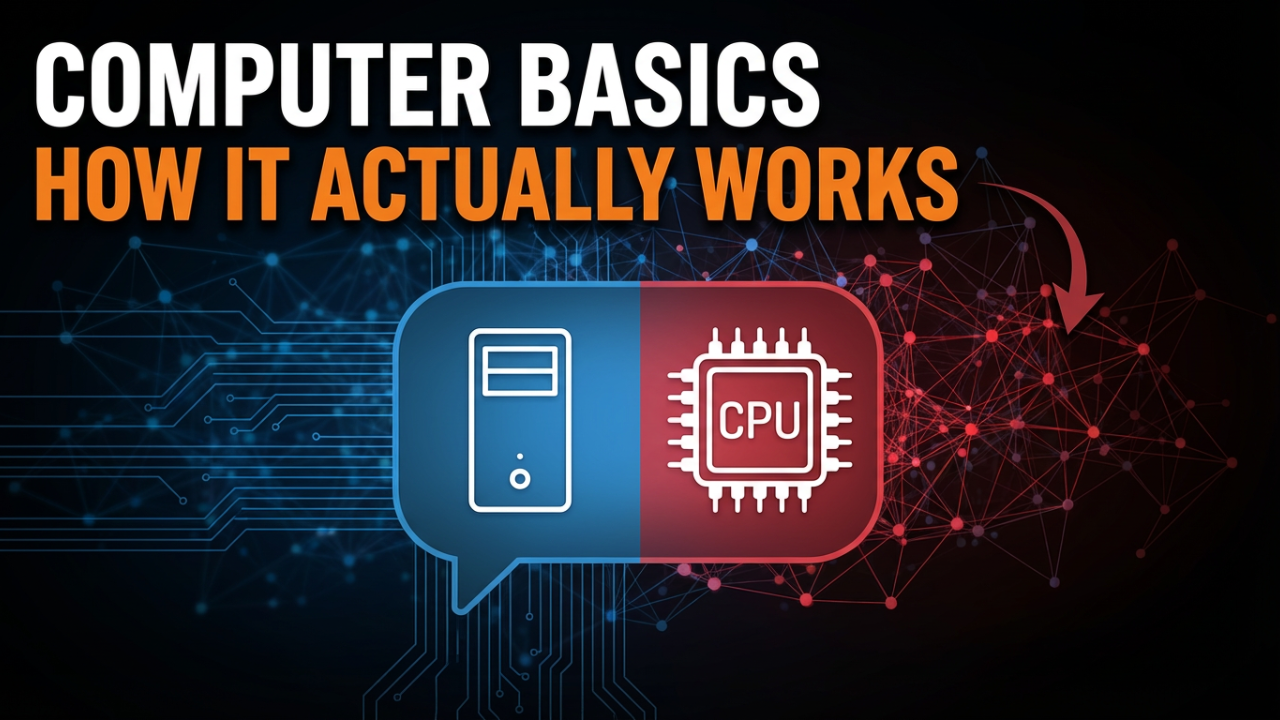
So in this article, we’re going to do two things together. First, we’ll walk through the simple, practical basics of using a computer, step-by-step. No jargon, no confusing terms. We’re going to go from a machine that’s completely off, to surfing the internet with confidence. Then, once you’re comfortable in the driver’s seat, we’ll peek under the hood and see the magic that makes it all work. By the end of this article, you won’t just know *how* to use your computer; you might truly *understand* it for the first time. Let’s turn that mystery into mastery.
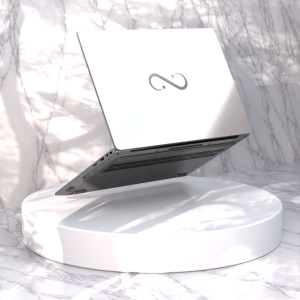
ILIPUTER- International Computer Manufacturing Co.
Act 1: The “How-To” Guide: Your Practical Path to Confidence
Section 1: The Absolute Basics – Power and Peripherals
Alright, let’s start at the very beginning. In front of us is a computer. This might be a desktop—the kind with a tower and a separate screen—or a laptop, where it’s all built into one foldable package. The steps we’re about to take are pretty much identical for both.
First things first, we need to bring this machine to life. To do that, we have to find the power button, which can sometimes feel like a little treasure hunt. On a desktop tower, it’s usually on the front, often near the top. It’s typically the largest button and might have that universal power symbol on it: a circle with a small line breaking through the top. On laptops, it can be a bit trickier. Look above the keyboard, on the side, or even on the keyboard itself on some newer models. Take a second to find it. That’s your ignition key.
But before we press it, let’s make sure our computer has all its connections, what we call peripherals. For a desktop, there are a few key cables. First is the main power cable, running from the back of the tower to a wall outlet. Make sure it’s snug on both ends. Next is the monitor cable, which connects the screen to the tower so you can actually see what you’re doing. Then you have your keyboard and mouse, your main tools for talking to the computer. These almost always plug into rectangular slots called USB ports, which you can find on both the front and back of the tower. For a laptop, it’s way simpler: just make sure the power adapter is plugged into the wall and connected to the laptop, especially if the battery is low.
With our connections checked, it’s time. Go ahead and give that power button a single, firm press. No need to hold it down.
The first thing you’ll probably notice are sounds and lights. You might hear the whir of fans spinning up inside the case—that’s just the cooling system kicking on. You might see some lights flicker on the tower or keyboard. Then, on the screen, a logo will appear—maybe the brand of the computer, or the logo for its operating system, like Windows.
This startup process is called “booting up.” It’s a funny term, but all it means is the computer is waking up and running a quick checklist to make sure all its parts are working before it loads the main program that runs everything: the operating system. This can take anywhere from a few seconds to a minute.
Once it’s done, you’ll land on the login screen. This is a simple security step. It’ll ask for a password, a PIN, or maybe use your fingerprint or face to sign you in. Go ahead and enter your credentials. After you log in, you’ll be greeted by your digital home base: the desktop.
Section 2: Your Digital Welcome Mat – The Desktop
Welcome to the desktop. If a computer is a house, the desktop is the front hall. It’s the first space you see, and it’s where you can get to every other room. Let’s get familiar with the layout. It’s a simple space with three main features you’ll use all the time: the background, the icons, and the taskbar.
The background image, or wallpaper, is just there for decoration. You can change it to a picture of your family, a favorite vacation spot, or just a solid color. You can make this space your own, but we don’t need to worry about that right now.
Scattered on this background, you’ll see small pictures with labels. These are icons. Think of an icon as a doorway. Each one is a shortcut that takes you directly to a program, a file, or a folder. You might see an icon for your web browser to get on the internet, or for a document you were working on. We use them to get to our most-used stuff quickly.
Finally, look at that long bar that usually runs along the bottom of your screen. This is the taskbar, and it’s your command center. It’s always there, and it does a few important things. On the far left, you’ll find one of the most important buttons on your whole computer: the Start button. It usually looks like a window, the logo for Microsoft Windows.
Clicking the Start button opens the Start Menu. This is the real gateway to everything on your computer. From here, you can see a list of all your programs, get to your settings, search for any file, and—most importantly—properly shut down your computer when you’re done. Go ahead and click the Start button just to see the list. You don’t have to open anything, just get a feel for what’s there. To close it, just click anywhere else on the desktop.
Back on the taskbar, next to the Start button, you might see a few other icons. These are your “pinned” apps—your favorites that you want to open with a single click. The middle section of the taskbar shows you what programs are currently open and running, so you can easily switch between them. And over on the far right is the system tray, which shows the time and date, your internet status, and your volume level.
Section 3: The Tools of the Trade – Mouse and Keyboard
Now that we know the lay of the land, let’s get comfortable with our tools: the mouse and the keyboard. These are basically your hands in the digital world.
Let’s start with the mouse. Place your hand on it so your index finger rests on the left button and your middle finger rests on the right. As you move the mouse on your desk, you’ll see a little arrow move on the screen. This arrow is called the cursor, and it’s how you point at things.
The mouse has three main tricks. The most common is the left-click, which you do with your index finger. Think of it as the “do it” button. If you move your cursor over an icon and click the left button once, you’ll see the icon get highlighted. You’ve just selected it. To actually open that program, you often need to double-click—that’s two quick presses of the left mouse button. Let’s try it. Find an icon like the Recycle Bin and double-click it. A window should pop up. To close it, just move your cursor to the red ‘X’ in the top-right corner of that window and left-click it once.
The second trick is the right-click, done with your middle finger. The right-click is the “what are my options?” button. It is incredibly useful. Move your cursor to an empty spot on your desktop and click the right mouse button once. A little menu will appear. This is called a context menu, because the options it gives you depend on what you clicked on. Now, try right-clicking on an icon. You’ll see a different menu with options like “Open,” “Rename,” or “Delete.” The right-click is your secret weapon for figuring out what you can do.
The third feature is the scroll wheel, right between the two buttons. This just moves you up and down in a window that has a lot of content, like a long webpage. You just roll it with your finger.
There’s one more key mouse skill: clicking and dragging. This is how you move things. Put your cursor over an icon, then press and hold down the left mouse button. Don’t let go. While still holding the button, move your mouse. You’ll see a little ghost of the icon move with your cursor. Drag it somewhere else on the desktop and then let go of the button. You’ve just moved an icon! This same move is used to resize windows or to select a bunch of files at once.
Now for the keyboard. It can look intimidating with all those keys, but let’s just focus on the essentials. The letter and number keys work just like a typewriter. The big key at the bottom is the spacebar, and the Enter key is for starting a new line or confirming an action, like a final “OK.” The Backspace key erases what’s to the left of your cursor, while the Delete key erases to the right.
To type a capital letter, you hold down a Shift key while you press a letter. If you want to type IN ALL CAPS, press the Caps Lock key once. A little light will probably turn on to show you it’s active. Press it again to turn it off.
Finally, you have what are called modifier keys: Ctrl (Control), Alt, and the Windows key. By themselves, they don’t do much. But when you hold one of them down and press another key, they perform special shortcuts. For example, here’s a classic pro-tip: holding Ctrl and pressing ‘C’ copies selected text, and holding Ctrl and pressing ‘V’ pastes it somewhere else. You don’t have to memorize these now, just know they exist to help you work faster later on.
ILIPUTER- International Computer Manufacturing Co.
Section 4: Digital Organization – Files & Folders
As you use your computer, you’ll start creating things: documents, photos, and so on. These are all called files. To keep them from turning into a total mess, we use folders. Think of your computer’s storage as a giant filing cabinet. The files are the paper documents, and folders are the manila folders you use to group them together.
Let’s try it out. We’ll make a folder right on the desktop. Move your cursor to an empty spot on the desktop and right-click. Remember, that’s our “options” button. In the menu that pops up, move your cursor over “New.” A second menu will appear. At the top, you’ll see “Folder.” Left-click it.
Just like that, a new folder appears, with its name highlighted so you can type. Let’s call it “My Practice Folder.” Type that in and hit the Enter key. You’ve just made your first digital container. If you ever want to rename it, just right-click on the folder and choose the “Rename” option.
Now, a folder isn’t useful without files in it. So let’s make a simple text file. Click on your Start button. We’re looking for a basic program called Notepad. It’s a simple text editor included with Windows. You can either look for it in the program list or, even easier, just start typing “Notepad” in the search bar. Click the Notepad icon to open it.
A blank white window appears. Go ahead and type a sentence: “I am learning how to use a computer.”
Now, we have to save this. If you just close the window, your sentence is gone forever. To save, move your cursor to the top-left of the Notepad window and click on “File.” In the drop-down menu, click “Save As.”
This brings up the “Save As” window. It’s asking you two important questions: “Where do you want to save this?” and “What do you want to name it?” On the left side, you’ll see a list of places. We want to save it on the desktop in the folder we just made. So, click on “Desktop” in that list. Now you should see the contents of your desktop, including our “My Practice Folder.” Double-click on that folder to go inside it.
Now for the name. At the bottom, you’ll see a box next to “File name.” Click in that box and type a name, like “My First Note.” Then, click the “Save” button.
Your work is now safely stored. You can close Notepad by clicking the ‘X’. Now, go back to your desktop and double-click “My Practice Folder” to open it. Inside, you should see your file, “My First Note.” You can double-click it to open it again.
This process—making folders and saving files inside them—is how you organize everything on a computer. When you’re done with a file or folder, you can right-click on it and choose “Delete.” This sends it to the Recycle Bin, which is like a temporary trash can. You can empty the Recycle Bin later to permanently delete the files and get your space back.
**The Bridge: From Using to Understanding**
Okay, so now you know how to turn on the computer, get around the desktop, open programs, and manage your own files. With these skills, you can handle most everyday tasks. But have you ever wondered what’s really happening inside the box when you do something as simple as double-clicking an icon? How does the computer translate that tap of your finger into a full program running on your screen? It feels like magic, but it’s not. It’s a beautifully logical dance between the computer’s physical parts and its brain. So let’s shift gears. We’ve learned how to drive the car; now let’s look under the hood and see how the engine works.
Act 2: The “How-It-Works” Reveal: An Analogy-Driven Breakdown
Section 5: The Big Picture – Input, Processing, Output
Before we look at the individual parts, we need to understand the simple three-step cycle that governs everything a computer does: Input, Processing, and Output. To make it easy, let’s think about making coffee.
First, you provide the machine with what it needs: coffee beans and water. That’s your **Input**.
Second, the machine does its job. It grinds the beans, heats the water, and brews the coffee. It’s transforming the raw materials. That’s the **Processing**.
Third, you get the result: a cup of hot coffee. That’s the **Output**.
Every single computer in the world runs on this exact same principle. Let’s apply it to opening a program.
When you double-click your mouse on an icon, you are providing **Input**—a command.
The computer then has to think about that command. It figures out what you clicked, finds the program, and gets it ready. That’s the **Processing**.
Finally, the program’s window appears on your screen. That’s the **Output**.
There’s one more piece to this puzzle: **Storage**. In your kitchen, you had to have the coffee beans and the machine stored somewhere before you could start. A computer also needs a place to keep its programs and files when they’re not in use. That’s storage.
So the full cycle is: you provide an input, the computer processes it by grabbing something from storage and thinking about it, and then it produces an output. Now, let’s meet the team of components inside the computer that makes this all happen.
Section 6: The Core Components – Hardware Explained with Analogies
If you open up a computer, it looks like a mini-city of chips and wires. To understand it, let’s start with the foundation: the motherboard.
**The Motherboard: The City’s Infrastructure**
The motherboard is the huge circuit board that everything else plugs into. It’s not the brain, but rather the land and the road system for our computer city. Every other part—the brain, the memory, the storage—connects to it. It has a complex network of electrical pathways that let all the components talk to each other and get power. Without it, the brain couldn’t talk to the memory, and nothing would work. It’s the physical backbone connecting everything.
**The CPU (Central Processing Unit): The Brain**
Now for the most famous component: the CPU, or Central Processing Unit. This is the brain of the whole operation. Its one job is to execute instructions. Every single thing you do, from moving your mouse to opening a program, gets broken down into simple instructions that are sent to the CPU to be carried out.
The CPU is constantly running a super-fast cycle: fetch, decode, execute. First, it *fetches* the next instruction from the computer’s memory. Second, it *decodes* that instruction to figure out what to do. Third, it *executes* the command. It does this billions of times every second.
You’ll often hear about a CPU’s “cores” and “clock speed.” A core is like an individual brain. Early CPUs only had one, so they could only think about one thing at a time. Modern CPUs have multiple cores, allowing them to work on several tasks at once. That’s why you can play music, download a file, and browse the web at the same time.
Clock speed, measured in gigahertz (GHz), tells you how many instruction cycles the CPU can run per second. A gigahertz is one billion. So a 3 GHz CPU can perform that fetch-decode-execute cycle about three billion times per second. It’s this mind-boggling speed that makes everything feel instant.
**RAM and Storage: The Desk and The Filing Cabinet**
The CPU is a powerful brain, but it needs a place to work and a place to store things long-term. This is where we meet two parts that are often confused: RAM and Storage. The best analogy is a desk and a filing cabinet.
Imagine your office has a massive filing cabinet. This is your **Storage**. It holds every document you’ve ever created, all your research—everything. This is permanent, long-term storage. It’s where your computer keeps the operating system, all your programs, and all your files, even when the power is off.
Now, you decide to work on a project. You don’t work from inside the filing cabinet; that would be slow and awkward. Instead, you go to the filing cabinet, take out the files you need, and put them on your desk.
Your desk is your **RAM**, or Random Access Memory. RAM is the computer’s temporary, active workspace. When you double-click a program, the CPU orders a copy of that program’s data to be moved from the slow storage (the filing cabinet) into the super-fast RAM (your desk). The CPU can then access the data from RAM almost instantly.
The key thing about RAM is that it’s “volatile”—as soon as you turn the power off, everything on the desk is wiped clean. This is why you have to save your work. When you save a file, you’re telling the computer to take the version on your RAM-desk and put an updated copy back into the storage-filing-cabinet for safekeeping.
The more RAM you have, the bigger your desk. With a small desk, you can only work on a couple of things at once before it gets cluttered and slow. With a big desk, you can have your document, dozens of web tabs, and your email all open at the same time and switch between them smoothly. Today, 16GB of RAM is a great amount for smooth multitasking for most people.
For storage, there are two main types: the older Hard Disk Drive (HDD), which uses spinning magnetic platters, and the newer Solid-State Drive (SSD), which uses silent, faster memory chips. SSDs are the modern standard because they get files from the “filing cabinet” to the “desk” much faster, making your whole computer feel snappier.
**The GPU (Graphics Processing Unit): The Visual Artist**
There’s one more specialized brain in our computer city: the GPU, or Graphics Processing Unit. While the CPU is a general-purpose genius, the GPU is a master artist. Its main job is to take data from the CPU and turn it into the images, videos, and text you see on your screen. It’s responsible for the visual output.
For everyday things like showing your desktop or a webpage, the CPU can often handle the graphics itself. But for visually demanding tasks, like playing a realistic video game or editing a high-definition movie, a “dedicated” graphics card is a game-changer. This is basically a separate component with its own GPU and its own ultra-fast RAM, built just for creating images. It takes the heavy visual work off the CPU, allowing the whole system to run much better.
Section 7: The Mind in the Machine – Hardware vs. Software
So we’ve met the hardware: the motherboard, CPU, RAM, storage, and GPU. These are all the physical parts you can touch. But all this powerful hardware is just a pile of metal and silicon without something to tell it what to do. That “something” is **software**.
The best way to think about it is the relationship between a body and a mind. The hardware is the body—the brain, bones, and muscles. The software is the mind—the thoughts and instructions that tell the body what to do.
There are two main kinds of software.
First is the **Operating System**, or OS. You’ve heard of Microsoft Windows, Apple’s macOS, and Linux. The OS is the master program, the manager of the entire computer. It’s the conductor of the orchestra. It tells the CPU what to work on, manages what goes in and out of RAM, helps you save files, and allows all the hardware parts to communicate. It also provides the user interface—the desktop and menus—that lets you interact with the machine.
The second kind is **Applications**, or “apps.” These are the programs for specific tasks. Your web browser is an app. A word processor is an app. A video game is an app. These apps rely on the Operating System to work. They make requests to the OS, and the OS coordinates with the hardware to get the job done.
Now let’s put it all together. Let’s re-trace the simple act of double-clicking an icon and see how the whole team works together.
1. **Input:** You double-click the mouse. The mouse hardware sends an electrical signal to the motherboard.
2. **OS Coordination:** The motherboard sends this signal to the CPU. The Operating System, which is running on the CPU, sees the signal, recognizes it happened over a specific icon, and understands your command: “Open this program.”
3. **Storage to RAM:** The OS now tells the CPU to get the program files. The CPU sends a request through the motherboard to the storage drive (the filing cabinet). The storage drive finds the program’s data and sends a copy back across the motherboard into RAM (the desk).
4. **CPU and GPU Processing:** Now that the program’s instructions are in fast RAM, the CPU can start executing them. As it processes the code, it sends visual information to the GPU—the artist—telling it what the program’s window should look like.
5. **Output:** The GPU takes that info, renders the final image, and sends it to your monitor. The program window appears on your screen.
All of this—the input, the OS coordination, the data transfer, the processing, and the final output—happens in a fraction of a second. It’s not magic. It’s a breathtakingly fast chain of logical steps, a perfectly choreographed ballet between hardware and software working in total harmony.
Conclusion
Today, we’ve walked through two different worlds. We started in the practical world, learning the simple steps to use your computer with confidence. We built your skills as the driver. Then, we looked under the hood at the hidden world inside. We met the team of components—the CPU brain, the RAM desk, the storage filing cabinet—and we saw how they work with their software mind to turn your clicks into reality.
That feeling of mystery you might have had about computers? It doesn’t need to be there anymore. A computer isn’t some unknowable magic box. It’s a tool built on logical ideas that create something incredibly powerful. You’ve already taken the most important step just by choosing to understand it. That fear of “breaking something” can now be replaced with curiosity. Every click is no longer a question mark, but an instruction you’re in charge of.
I hope this journey has been empowering. You now have both the practical skills to use your computer and the knowledge to understand it. Keep exploring, keep clicking, and never be afraid to learn more.