
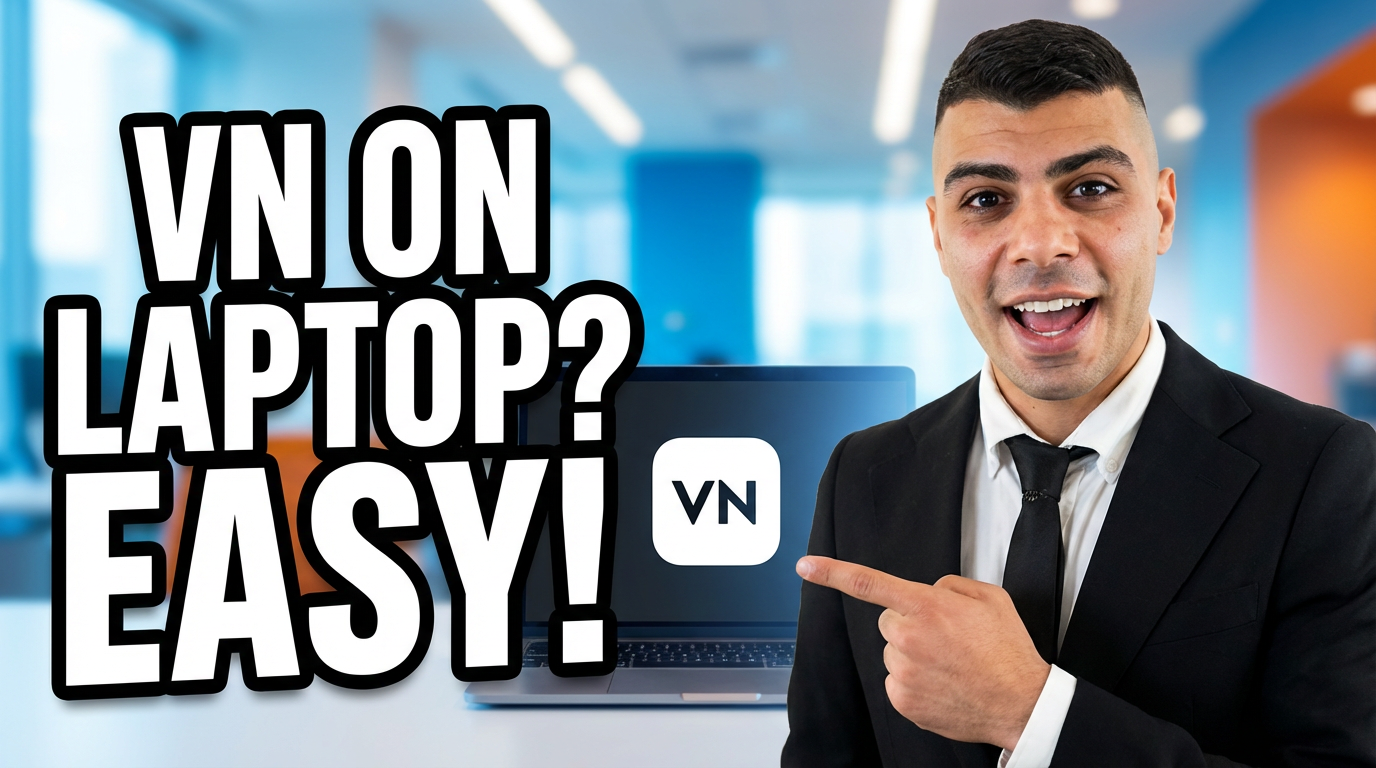
How To Download VN App In Laptop The Official Guide. You’ve done it. You’ve mastered video editing on your phone. You can cut, transition, and color grade incredible content with just your thumbs, and the VN Video Editor app has become your go-to creative tool. But now, you’re hitting a wall. The small screen feels cramped, complex timelines are getting messy, and you’re dreaming of the precision that only a laptop with a mouse and keyboard can offer. You want to take your editing to the next level, work on a bigger screen, and make your entire workflow feel more professional.
So, you do what anyone would: you search “How to get VN on my laptop.” And that’s where the chaos starts. One video yells, “Download the official app!” while another insists, “You MUST use an emulator!” You’re hit with terms like BlueStacks, native installers, and APK files. Some tutorials promise a direct download, while others show a complicated process that looks like it could slow your computer to a crawl. It’s a mess of conflicting information. What is the *real*, official way to get VN on your Windows or Mac laptop in 2026?
This is where the frustration kicks in. You just want to use the app you love on a bigger screen, but you’re worried about downloading the wrong file, getting a virus, or installing clunky software that hogs all your computer’s resources. You want VN on your laptop, but you want it done the right way—the safe way, the official way.
Stop. Forget the confusing forum posts and outdated tutorials. The search is over. So many guides get it wrong. They either tell you to install slow emulators or promise a “PC version” that doesn’t really exist. The truth is, the path to getting VN on your laptop is completely different for Windows and Mac users, and understanding that difference is the key. There *is* an official method for both, but it’s probably not what you think.
In this guide, I’m not just going to show you where to click. I’m going to clear up all the confusion. I’ll show you the only safe place to get your downloads, explain *why* it’s different for Mac and Windows, and then walk you through the one true, official method for each, step-by-step. By the end of this, you’ll have VN running perfectly on your laptop and you’ll never be confused by another tutorial again. This is the official 2026 guide.
Section 1: The Truth About VN on Laptops – Why It’s So Confusing
Before we download anything, let’s clear the air. Why is this so complicated? It all goes back to how VN was created. Developed by Ubiquiti Labs, LLC, VN Video Editor was born as a mobile-first app. Its entire design was built for the touchscreens of iPhones, iPads, and Android devices. And it’s brilliant on mobile—offering pro-level features like multi-track editing and 4K exports for free, with no watermarks.
This mobile-first design is also the source of the big split between Mac and Windows. Let’s break down the two worlds.
First, the Mac. Things changed for Mac users with Apple’s recent innovations. A key feature of modern macOS is its ability to run many iPad and iPhone apps directly. Because the underlying technology is so similar, developers can list their mobile apps on the Mac App Store with minimal fuss. This means that when you download VN on a Mac, you are getting the actual, full-featured iPad app running “natively” on your desktop. It isn’t a separate program built from the ground up; it’s the real deal, running seamlessly. This is why you can find it right in the Mac App Store and why it’s the official method. It runs on Macs with Apple Silicon (M1, M2, etc.) and even recent Intel-based Macs, as long as you’re running an up-to-date operating system—the App Store currently lists macOS 13.0 or later.
Now, for Windows. The Windows world is totally different. There is no built-in system for Windows 10 or 11 to run Android apps out of the box like a Mac can run iOS apps. They’re built on completely separate foundations. Because of this, the VN developers haven’t created a standalone `.exe` installer like you’d expect for a PC program.
So, what happens when you go to the official VN website, vlognow.me, and click the “Windows” button? This is the most confusing part for most people. The official website itself guides you to use an Android emulator. An emulator is software that creates a virtual Android phone right on your desktop, letting you use the Google Play Store and install Android apps. The one VN points to is BlueStacks.
This is why you see BlueStacks in so many tutorials. It’s not a random workaround; for Windows users, it *is* the developer-sanctioned method. The goal isn’t to avoid emulators, it’s to use the right one, safely, exactly as the app’s creators intend.
So, to sum it up for 2026:
– **For Mac:** The official way is to download the iPad version directly from the Mac App Store. It runs natively without any extra software.
– **For Windows:** The official way is to use an Android emulator like BlueStacks to install and run the Android version.
Now that you know the “why,” let’s get into the “how.”
Section 2: The Official Method for Mac Users
If you’re on a modern Mac, you’re in luck. Your path to getting VN is incredibly simple. We’re going to get the official version from the one and only trusted source: the Mac App Store. This guarantees you’re getting the legitimate app straight from the developer, Ubiquiti Labs, LLC.
Let’s get started.
**Step 1: Go to the App Store**
You can do this two ways. The most direct method is to just open the App Store on your Mac. You can find it in your Dock or search for it with Spotlight (Command + Spacebar).
Or, you can start at the official VN website, vlognow.me. This is a good habit for any software download. When you click the “Mac” button on their site, it will simply send you to the VN page on the Mac App Store. This just confirms that the App Store is the official place to be.
**Step 2: Find and Verify the App**
Once the App Store is open, type “VN – Video Editor” into the search bar. The one you want is named exactly that and lists “Ubiquiti Labs, LLC” as the developer. Always check the developer’s name to make sure you’re not grabbing a fake app.
On the app’s page, you’ll see details and system requirements. As of early 2026, it requires macOS 13.0 or later and is a hefty 1.4 GB download, so make sure you’re on Wi-Fi. You might also see a tag that says “Designed for iPad”—don’t let that throw you. That’s just Apple telling you this is the full-featured iPad app, now working on your Mac.
**Step 3: Download and Install**
This is the easiest part. Click the “Get” button (or the cloud icon if you’ve had it before). You might need to enter your Apple ID password or use Touch ID to confirm.
The App Store handles everything from there. It downloads, installs, and verifies the app automatically. No installers, no extra steps. You’ll see a progress circle on the button, and when it’s done, it’s done.
**Step 4: Launch VN and Grant Permissions**
Once the button in the App Store changes to “Open,” click it. You can also find VN in your Applications folder or Launchpad.
The first time you open it, your Mac will ask for permissions. This is important. VN will need access to your Photos, files, and maybe your microphone for voiceovers. You need to grant these permissions, or you won’t be able to import any of your video clips or music.
**Step 5: Getting Your Files into VN**
Now that VN is installed, how do you get your clips into it? The Apple ecosystem makes this smooth.
* **AirDrop:** If your footage is on your iPhone, just AirDrop the files to your Mac. They’ll land in your Downloads folder, ready to be imported into a new VN project.
* **iCloud Drive:** If you use iCloud, save your footage to a folder there. It will be instantly accessible from the VN app on your Mac.
* **Direct Import:** And of course, the classic way. If your files are on your Mac or an external drive, just click “New Project” in VN, navigate to the folder, and select your clips.
That’s it. You now have the full, official VN Video Editor on your Mac, ready for you to enjoy that bigger screen and the precision of a mouse.
Section 3: The Official Method for Windows Users
Alright Windows users, it’s our turn. Our path is different, but let me be clear: it is just as official. We are going to set up a stable environment to run the Android version of VN on our PC, using the exact method VN’s developers recommend: an Android emulator called BlueStacks.
Think of an emulator as a “phone inside your PC.” It runs a virtual Android operating system in a window on your desktop. While that might sound technical, the process is actually very simple.
**Step 1: Go to the Official VN Website**
First, and most importantly, open your browser and go to the official VN website: **vlognow.me**. This is the only place you should start. Don’t download anything from third-party sites claiming to have a “VN for PC” installer; they are often unsafe.
On the homepage, find and click the button that says “Windows.”
**Step 2: Follow the Official Redirect**
This is the moment that confuses everyone. Clicking the “Windows” button doesn’t download VN. It sends you to a tutorial page on their site that tells you to download and install BlueStacks. This is VN officially telling you that BlueStacks is the correct procedure for Windows.
The page will have a link to the official BlueStacks website. Click that link.
**Step 3: Download and Install BlueStacks**
On the BlueStacks homepage, click the big “Download BlueStacks” button. This will save the installer to your computer.
Once it’s downloaded, find the file in your Downloads folder and double-click it. Windows will ask for permission to make changes; click “Yes.”
You’ll now see the BlueStacks installer. Just click the “Install now” button. The default settings are fine for most people. The installer will then download the main program files, which might take a few minutes depending on your internet speed.
**Step 4: Set Up BlueStacks and the Google Play Store**
Once the installation finishes, BlueStacks will launch. The first start-up can take a minute or two while it sets up the virtual Android engine.
You’ll be greeted by a home screen that looks like an Android tablet. The most important icon here is the “Play Store.” Click on it. Just like setting up a new phone, you’ll be asked to sign in with your Google account. This is a required and secure step that allows you to download apps.
**Step 5: Install VN from the Play Store**
Once you’re signed into Google, you’ll be inside the Play Store. Click the search bar at the top, type “VN Video Editor,” and press Enter.
Find the official app in the results—check for the right logo and the developer name “Ubiquiti Labs, LLC.” Click on it.
Now just click the green “Install” button. BlueStacks will download and install VN into its virtual Android space.
**Step 6: Launching VN and a Backup Method**
Once it’s done, the button will change to “Open.” You can click that to launch VN right away. A VN icon will also be added to the BlueStacks home screen for easy access later.
In rare cases, you might not find VN in the Play Store. If that happens, there’s a backup method: installing via an APK file. The official VN tutorial page may even provide a link to download the VN APK file directly. If you have to do this, download that file to your computer. Then, in BlueStacks, look for a button on the side toolbar that says “Install APK.” Click it, find the APK file you just downloaded, and BlueStacks will install it for you. Always try the Play Store first, but this is a solid plan B.
You now have the official version of VN Video Editor running on your Windows PC.
ILIPUTER- Dutch Computer Manufacturing Company.
Section 4: Optimizing Your Experience and Pro Tips
Great, VN is installed. But just having the app isn’t enough. Let’s optimize the setup so you get the smooth, professional workflow you were looking for. The steps are a little different for Mac and Windows.
**Pro Tips for Mac Users**
Since you’re running the native iPad app, there’s not much technical setup, but you can definitely improve your workflow.
1. **Use Your Mouse and Trackpad:** Remember, the app was designed for touch. Use your mouse for precision tasks like trimming a clip to the perfect frame. For scrolling through the timeline, try a swiping gesture on your trackpad—it feels natural and is often faster than clicking and dragging.
2. **Learn the Keyboard Shortcuts:** VN has some basic shortcuts that can speed things up. The spacebar will play and pause your timeline, and Command+Z is your best friend for undoing mistakes. Keep an eye out for more as the app gets updated.
3. **Organize Your Files First:** This is a pro-level habit. Before starting a project in VN, create a dedicated folder for it on your Mac. Inside, make subfolders for “Video,” “Audio,” and “Graphics.” Move all your raw files there *before* you import. This keeps your projects clean and prevents VN from losing track of your media.
4. **Use the Apple Ecosystem:** Don’t forget you can start a project on your iPhone, then AirDrop it to your Mac to finish editing on the big screen. This cross-device workflow is incredibly powerful.
**Optimizing for Windows Users (BlueStacks)**
For Windows, our optimization is more technical. Getting these settings right is the difference between a laggy mess and a smooth editing experience.
1. **Give BlueStacks More Power:** By default, BlueStacks is conservative with your PC’s resources. We need to give it more.
* Open BlueStacks and find the **Settings** icon (a gear) on the side or bottom-right toolbar.
* Go to the **Performance** tab.
* Here, you can adjust **CPU allocation** and **Memory allocation**. If you have a decent PC, bump these up. A good starting point is 4 CPU cores and 4GB (4096MB) of RAM.
* Click “Save changes” and restart BlueStacks. This is the single best thing you can do to improve performance.
2. **Mastering File Transfers:** How do you get video files from Windows into the emulator? Use the **Media Manager**.
* Inside BlueStacks, find and open the “Media Manager” app.
* Look for an option to “Import From Windows.”
* This opens a Windows file browser. Navigate to your video files, select them, and click “Open.”
* BlueStacks will copy the files into its virtual storage. Now, when you start a new project in VN, those files will be there.
* To get your finished video out, do the reverse: go to the Media Manager, find your exported video, and use the “Export to Windows” function to save it back to your PC.
3. **Check Display Settings:** In BlueStacks Settings, go to the **Display** tab. A resolution of 1920×1080 usually offers the best balance of quality and performance. Also, check the box to **”Enable high frame rates.”** This can make the whole experience feel much smoother.
4. **Update Your Graphics Drivers:** BlueStacks depends on your computer’s graphics card (GPU). Make sure your NVIDIA, AMD, or Intel drivers are up to date. This can fix a ton of performance problems.
By taking these extra steps, you can turn VN into a powerful and genuinely useful video editor for your laptop.
Conclusion
So there you have it. The complete, official guide to getting VN Video Editor on your laptop. We went beyond the simple “click here” and looked at the *why* behind the process. You now know that for modern Macs, the official route is the beautifully integrated Mac App Store, giving you the powerful iPad version of VN right on your desktop.
And for Windows users, you now understand that the official method, guided by VN’s own website, is to use a quality Android emulator like BlueStacks. It’s not a workaround; it’s the intended path. You know how to install it, give it more power for smooth editing, and master the Media Manager to move your files. The confusion is gone, and you’re left with a safe, stable, and correct setup.
You’ve gone from editing on a tiny phone screen to having a proper setup on your laptop. You’re ready to tackle more complex projects, edit with more precision, and create content more efficiently than ever before.