

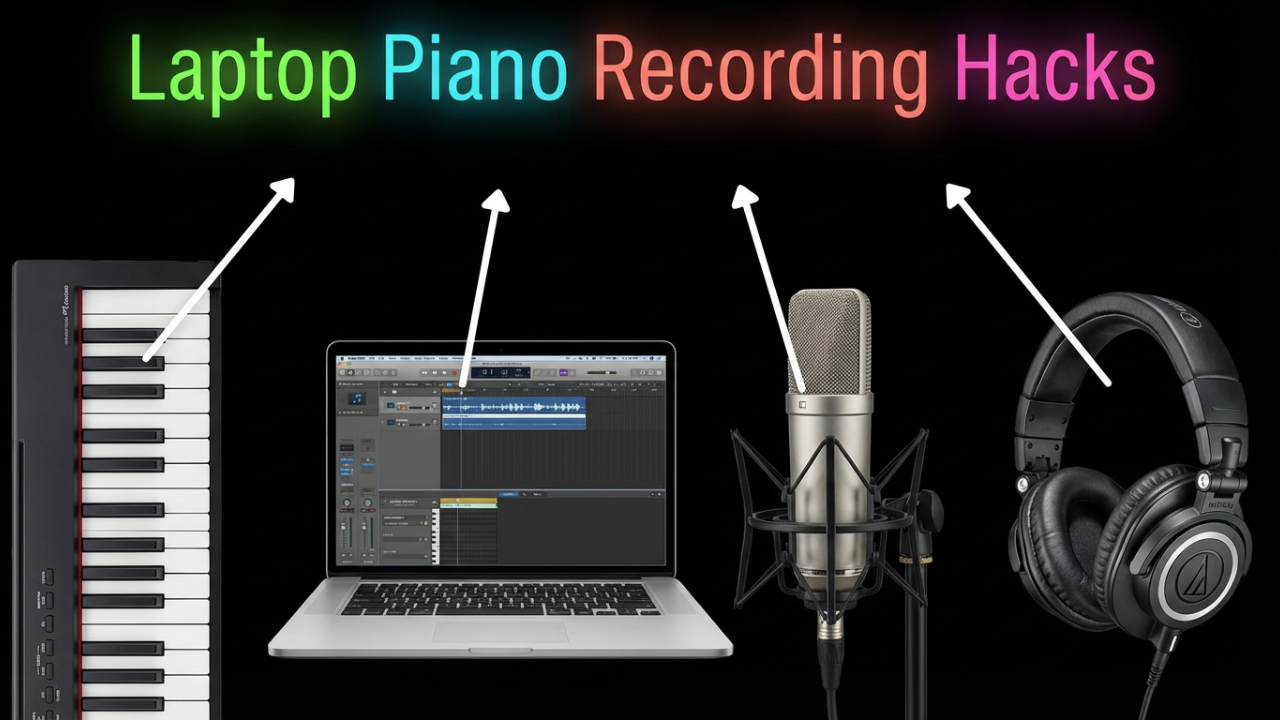
How To Record Piano On A Laptop The Right Way? Does this sound familiar? You’ve got a beautiful digital piano, a perfectly good laptop, but every time you try to record them together, you get… this. This crackly, quiet, unusable mess. You’ve probably lost hours messing with cables, mysterious software settings, and trying to make sense of forum posts from 2008, only to end up with audio that’s noisy, delayed, or just plain broken. It’s enough to make you want to quit.
But what if I told you that there’s a clear, step-by-step method to not only fix this, but to unlock a level of quality and creative freedom you didn’t even think was possible? We’re going to go beyond just getting *a* sound; we’re going to get *the* sound.
I’ll show you how to capture both the rich, authentic audio from your piano and the incredibly flexible performance data, called MIDI. By the end of this, you’ll have the confidence to make professional-sounding piano recordings every single time, without the headache. So, let’s get this right.

Section 1: The Two Worlds of Recording: Audio vs. MIDI
Before we plug in a single cable, we need to wrap our heads around the single most important concept in modern recording: the difference between Audio and MIDI. I promise this isn’t as complicated as it sounds, but getting this right is the key that unlocks everything else.
Think of it this way: **Audio is like a photograph.** It’s a direct snapshot of a sound wave. When you record audio, you’re capturing the actual sound your piano makes—its unique character, the pedal noises, all of it. It’s authentic, but just like a photo, it’s “baked in.” If you take a blurry photo, you can’t just make it sharp later. In the same way, if you record a wrong note in an audio track, that wrong note is there for good. You can’t fix it without re-recording the whole part.
Now, **think of MIDI as the sheet music.** MIDI (Musical Instrument Digital Interface) contains zero sound. None. Instead, it’s a set of instructions. It’s just data that says: “Play a C-sharp, at this exact moment, with this much force (we call that velocity), and hold it for this long.” A MIDI file is tiny because it’s basically just a list of commands.
So, what’s the magic of MIDI? Because it’s just instructions, you can change them whenever you want. Played a wrong note? Just click on it in your software and drag it to the right one. Timing a little off? You can “quantize” the notes to snap them perfectly to the beat. Want to hear your piano part played by a string orchestra, a vintage synth, or a grand piano that costs more than a house? You can, because you can tell that MIDI data to control any virtual instrument you have. It gives you god-like flexibility after you’ve recorded.
Here’s a quick breakdown:
* **What it Captures:** Audio captures the actual sound. MIDI captures the performance—the notes, timing, and how hard you played.
* **Editing Flexibility:** With audio, you can’t fix a wrong note. With MIDI, you can change literally anything: notes, timing, dynamics, and even the instrument itself.
* **Sound Source:** In audio recording, the sound comes from your digital piano. In MIDI recording, the sound is made by a “virtual instrument” (or VST) inside your computer, which reads the MIDI instructions.
* **File Size:** Audio files are large. MIDI files are incredibly small.
The goal here, the “right way” to do this, is to record **both at the same time.** This gives you the best of both worlds: the authentic audio from your piano as a rock-solid reference, and the editable MIDI data for total control. This is how the pros do it, and it’s what we’re going to master today.
Section 2: Your Essential Toolkit – Hardware and Software
Alright, now that we know the ‘what,’ let’s get into the ‘with.’ Getting your gear right is half the battle, but the good news is you don’t need to spend a fortune. Let’s break down the essentials.
**The Hardware Trinity: Piano, Interface, and Laptop**
1. **Your Digital Piano:** First, check the back of your piano for its outputs. You’re looking for two kinds of connections. First are the audio outputs, which are almost always 1/4-inch jacks labeled “L/MONO” and “R” (for Left and Right). These are for capturing your piano’s actual sound in stereo. If you only have a headphone jack, don’t worry, we can work with that too. Second, you need a MIDI connection. On most modern pianos, this is a square-ish port labeled “USB to Host” or “USB MIDI.” This is the easiest way to send MIDI to your computer. Older keyboards might have round, 5-pin “MIDI OUT” ports, which also work but require a different cable.
2. **The Audio Interface:** For 99% of setups, this is the non-negotiable heart of your studio. An audio interface is a small box that acts as the bridge between your piano’s sound and your laptop. So why can’t you just use your computer’s microphone jack?
* **Sound Quality:** The audio converters in an interface are miles better than the cheap parts in a laptop. This is the difference between a noisy, thin recording and a clean, professional one.
* **Proper Inputs:** Interfaces have the correct 1/4-inch inputs designed for the signal from your piano.
* **Latency:** This is the big one. Latency is that frustrating delay between when you press a key and when you hear the sound from your computer. An audio interface is built for low-latency performance, which is essential.
To record in stereo, you’ll need an interface with at least **two line inputs**. A fantastic, popular choice for starting out is the Focusrite Scarlett 2i2 or a similar model from brands like Audient, SSL, or MOTU. Many of these also have MIDI inputs, which can be super useful.
Now, it’s worth noting that some digital pianos, often from brands like Yamaha or Roland, have a USB audio interface built-in. Models like the Yamaha YDP-164 can send CD-quality digital audio directly to a computer over a single USB cable. If your piano has this specific “USB Audio” feature, you might not need a separate interface, but for most people, and for the most versatile setup, the external audio interface is the way to go.
3. **Your Laptop:** The great news is most modern Macs and PCs are more than powerful enough for this. If it has a USB port for the audio interface, you’re good to go.
**The Necessary Cables: Connecting the Dots**
This is where people get tripped up, but it’s simple once you see it.
* **For Audio:** To record in stereo, you need **two 1/4-inch TS cables** (standard instrument cables). One goes from your piano’s “L” output to Input 1 on your interface. The second goes from the piano’s “R” output to Input 2. If you only have a headphone jack, you’ll need a special **stereo breakout cable** that has a single stereo plug on one end and splits to two mono 1/4-inch plugs for Inputs 1 and 2 on your interface.
* **For MIDI:** This depends on your piano.
* If you have a “USB to Host” port, you just need a standard **USB Type-A to Type-B cable** (the kind most printers use). One end goes to your piano, the other to your laptop.
* If you have 5-pin MIDI ports, you’ll need either a dedicated **USB-to-MIDI cable** or an audio interface with MIDI ports built-in. If your interface has them, you just run a standard 5-pin MIDI cable from your piano’s “MIDI OUT” to the interface’s “MIDI IN.”
**The Digital Command Center: Your Software (DAW)**
Finally, you need the software to record, edit, and mix everything. This is your **Digital Audio Workstation**, or **DAW**.
You absolutely do not need to spend hundreds of dollars. There are amazing free options:
* **GarageBand:** If you’re on a Mac, you already have this. It’s user-friendly and perfect for this job.
* **Cakewalk by BandLab:** For Windows users, this is a gift. It’s a full-blown professional DAW that’s completely free.
* **Reaper:** This is a pro-level DAW with a very generous “free trial” that never truly expires (though you should buy the affordable license if you use it). It’s lightweight and incredibly powerful.
* **Audacity:** While Audacity is great for simple audio editing, it isn’t ideal for the dual audio/MIDI method we’re focusing on today because it lacks robust, built-in support for MIDI instruments and sequencing, often requiring complicated workarounds. For this tutorial, I really recommend starting with one of the other DAWs.
I’ll be showing this in a standard DAW, but the principles are universal and will apply to any program you choose.
Section 3: The Definitive Method – Recording Audio and MIDI Simultaneously
This is the moment. We have our gear, we get the concepts, now let’s put it all together. Follow these steps carefully, and you’ll get a perfect recording every time.
**Part 1: The Physical Connections**
Let’s get everything wired up. This should only take a minute.
1. **Power Down:** Before plugging anything in, turn everything off and turn all volume knobs down. It’s a good habit to prevent any loud, speaker-damaging pops.
2. **Connect Audio:** Take your two 1/4-inch cables. Plug one into the “L / MONO” output on your piano and into “Input 1” on your audio interface. Take the second cable and go from the “R” output on the piano to “Input 2” on your interface. That’s your stereo audio connection.
3. **Connect MIDI:** If you’re using USB, connect the cable from your piano’s “USB to Host” port to a USB port on your laptop. If you’re using 5-pin MIDI through your interface, connect a MIDI cable from your piano’s “MIDI OUT” to the interface’s “MIDI IN.”
4. **Connect Interface to Laptop:** Use the USB cable that came with your interface to connect it to your laptop. A few lights should pop on.
5. **Headphones Are Key:** Plug your headphones directly into the headphone jack on your **audio interface**, not your laptop. This is crucial for avoiding latency. Now, turn the internal speakers on your digital piano all the way off. You can do this with a button, or by just plugging a spare adapter into your piano’s headphone jack to mute them. This stops you from hearing the piano’s direct sound and the slightly delayed computer sound at the same time.
That’s it for the physical setup. Now for the brains of the operation.
**Part 2: Configuring Your DAW**
Open your DAW. First thing’s first, we need to tell it what hardware to use.
1. **Select Your Audio Device:** Find your DAW’s settings or preferences, and look for the “Audio” or “Audio Device” tab. You need to select your audio interface as both the **Input Device** and the **Output Device**. For example, on Windows, you might select “Focusrite USB ASIO,” or on a Mac, “Scarlett 2i2.” This tells the DAW where to listen for sound and where to send it.
2. **A Note on Drivers (Windows Users):** On Windows, you’ll want to use an **ASIO driver**. Your interface comes with its own ASIO driver that you should install. ASIO bypasses some of Windows’ clunky audio processing to give you the low-latency performance you need. Always use the specific ASIO driver for your interface.
3. **Enable Your MIDI Device:** In the same preferences menu, you’ll find a “MIDI” tab. Find your piano in the list of MIDI inputs (it might be the name of your keyboard or your interface) and make sure it’s enabled or checked. This tells the DAW to listen for MIDI data from your keyboard.
**Part 3: Creating and Arming Your Tracks**
Now let’s create the digital “tape tracks” to record on.
1. **Create a Stereo Audio Track:** First, create a new **Audio Track**. By default, it might be mono. You need to set this track’s input to be a **Stereo** pair, usually labeled “Input 1/2” or “Stereo In.” This tells the track to record from both interface inputs as a single stereo file. Let’s rename this track “Piano Audio.”
2. **Create a MIDI Track:** Next, create a new **MIDI Track** and rename it “Piano MIDI.”
3. **Load a Virtual Instrument:** Remember, a MIDI track needs an instrument to “play.” On your “Piano MIDI” track, load a Virtual Instrument (also called a VSTi or plugin). Your DAW will have some built-in instruments, including a piano. For an even better sound, you can download amazing free piano plugins like Spitfire Audio’s LABS Soft Piano.
4. **Set the MIDI Input:** Make sure your MIDI track’s input is set to receive MIDI from your piano. You can usually set it to “All MIDI Inputs” or select your specific keyboard.
5. **Arm the Tracks:** This is the final step before recording. On both the “Piano Audio” and “Piano MIDI” tracks, click the “Record Arm” or “Record Enable” button (it’s usually a little red button). When both are lit up, your DAW is ready to record on both tracks at once.
**Part 4: Setting Your Levels and Recording**
We’re almost there. This is all about getting a clean signal without distortion.
1. **Set Audio Gain:** With both tracks armed, play your piano at the loudest you intend to perform. Watch the meters on your “Piano Audio” track. You want to adjust the “Gain” knobs for Inputs 1 and 2 on your actual audio interface. Turn the gain up so the meter bounces high, but **never hits red.** A good target for your loudest notes is around -12dBFS to -6dBFS inside your DAW. This gives you plenty of “headroom” and prevents digital distortion, which is impossible to fix.
2. **Check MIDI Signal:** While playing, you should also see a small light flashing on your “Piano MIDI” track, confirming that it’s receiving the data.
3. **Hit Record!** Take a deep breath. Press the main record button in your DAW, wait for the count-in, and play your piece. You’ll see a beautiful stereo waveform being drawn on your audio track, and a series of little blocks appearing on your MIDI track. You are now recording your piano the right way.
When you’re done, hit stop. Congratulations! You’ve successfully captured both the pristine audio of your piano and the perfectly editable MIDI data of your performance.
Section 4: The Power of Post-Production – Editing and Enhancing
You did the hard part. The recording is done. Now, the real fun begins. This is where using both audio and MIDI shows its true power.
Let’s see what you can do with these two tracks.
**Working with Your MIDI Track: The Ultimate Safety Net**
Your “Piano MIDI” track is your secret weapon. If you solo this track, you’ll hear the virtual piano you loaded playing your performance back. Now, open the MIDI editor for this track, often called the “Piano Roll.” You’ll see a grid with piano keys on the side and a timeline. Your performance is a set of colored bars—each bar is a note.
* **Fixing Wrong Notes:** Hit a C instead of a C-sharp? In the audio track, that’s permanent. Here, you just find that one wrong bar, click it, and drag it up to C-sharp. Done. The mistake is gone.
* **Correcting Timing (Quantization):** Was some of your playing a little rushed or behind? Most DAWs have a “Quantize” function. You can select some notes and tell the software to snap them to the nearest grid line (like an 8th or 16th note). A little bit of quantization can really tighten up a performance. Just don’t overdo it, or it can sound robotic.
* **Adjusting Dynamics (Velocity):** Maybe you hit one chord way too hard. The “velocity” of each note is recorded. In the piano roll, you can select any note and drag its velocity up or down, effectively changing how “hard” it was played. This gives you complete control over your dynamics after the fact.
* **Experimenting with Sounds:** This is where it gets really creative. You don’t like the virtual piano you used? Mute it and load a different one. Try a cinematic felt piano. Try a classic electric piano. Try a full string section. The MIDI data can play *any* virtual instrument you load. You can layer multiple instruments to create huge, lush textures. The possibilities are endless.
**Working with Your Audio Track: The Authentic Core**
Now, solo your “Piano Audio” track. This is the pure, rich sound of your actual digital piano. It has a character that might be hard to replicate with a plugin.
* **The Authentic Sound:** Sometimes, the sound of your own piano is exactly what you want. If you played the part perfectly, this audio track might be all you need. You can add effects like reverb and EQ to polish it up.
* **A Perfect Reference:** The audio track is the perfect guide for editing your MIDI. If you’re not sure about a rhythm in the piano roll, listen back to your original audio to remind yourself of the feel and timing you intended. Then you can adjust your MIDI notes to match that human groove instead of just snapping everything to a rigid grid.
**The Hybrid Workflow: Combining Both for Pro Results**
This is the workflow the pros use to get the absolute best results.
1. **Record Both:** Just like we did.
2. **Edit the MIDI:** Go into your MIDI track and fix everything—wrong notes, timing, dynamics—until the performance is perfect. You now have a flawless “master” performance in MIDI form.
3. **Choose Your Sound Source:** Now you have a choice.
* **Option A (Using a VST):** If you love the sound of a high-quality piano plugin, your work is basically done. Your perfect MIDI track is now triggering a world-class instrument.
* **Option B (The Re-amping Trick):** This is a cool one. What if you love the sound of your *own* digital piano, but the original audio take had mistakes? You can send your *perfected* MIDI from the computer *back* to your piano and re-record its audio. This requires a MIDI connection from your computer’s MIDI OUT to your piano’s MIDI IN. You set the MIDI track’s output in your DAW to your interface’s MIDI port, hit play, and your digital piano will start playing itself using your edited MIDI file. You can then record its audio onto a new track. The result is a perfect audio performance with the unique sound of your own instrument.
This hybrid approach gives you the editing power of MIDI with the sonic authenticity of real hardware or high-end software. This is the method that removes the barriers between the music in your head and the final recording.
Conclusion
So, let’s bring it all home. We started with that frustrating, all-too-common problem of a weak, unusable piano recording.
We demystified the two worlds of Audio and MIDI—the sonic photograph and the editable sheet music. We learned that the key is to capture both at the same time.
We built our toolkit: the right cables, the crucial audio interface for quality and no-latency performance, and the powerful, free DAW software that runs the whole show.
And most importantly, we walked through the definitive, step-by-step recording process. From plugging everything in, to configuring the software, to arming both a stereo audio and a MIDI track, and setting perfect levels. You now have a foolproof method for a clean capture, every single time.
We’ve seen how this approach gives you incredible power later on. The freedom to fix any mistake, change any note, and experiment with endless sounds using MIDI is a creative game-changer, all while keeping the authentic audio of your own instrument as your anchor.
The next time you sit down to record, you don’t have to guess or hope for the best. You have a process. You have the knowledge. You have control. The barrier between you and a professional-sounding piano recording is officially gone.
Thanks for reading. Now go make some music.