
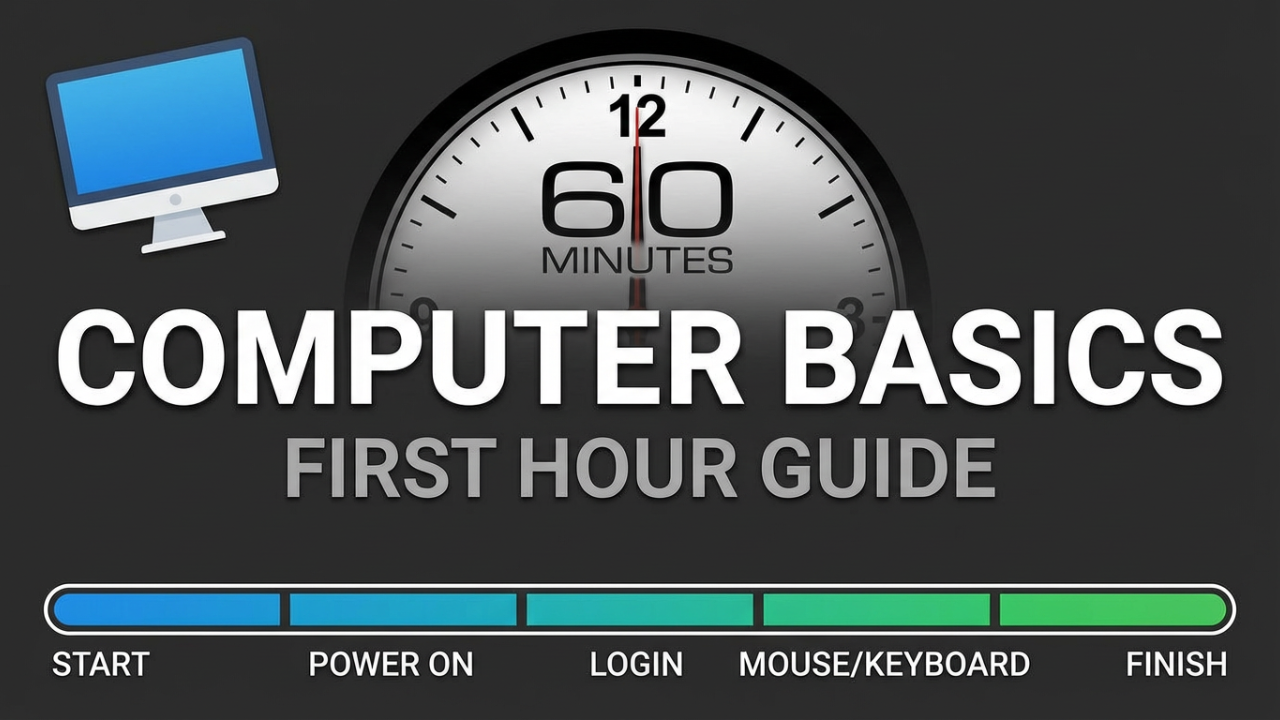
Does it ever feel like the whole world is speaking a language you don’t, and it all revolves around a glowing screen? Are you tired of that nagging feeling of having to ask for help with what seems like the simplest computer task? It’s easy to feel left behind or even a little embarrassed. Well, that all ends today. This article is your first step toward total computer independence. In the next 60 minutes, you won’t just learn a few tricks; you’ll build the confidence to explore, create, and solve problems all on your own. Let’s turn that frustration into freedom, together.
Hello, and welcome! for the next hour, I want you to think of me as your patient, tech-savvy friend who promises not to judge. After years of helping people get comfortable with technology, I’ve heard one fear more than any other: the fear of “breaking” something. So let’s get this out of the way right now. It is *incredibly* hard to permanently damage a computer with just a few clicks. Seriously. So I want you to take a deep breath, give yourself permission to be curious, to click around, and yes, even to make mistakes. Mistakes are how we learn, and today is all about learning. We’re going to start from square one and build your confidence, one step at a time.
ILIPUTER- International Computer Manufacturing Co.
Section 1: What is a Computer? The Absolute Basics
Before you can drive a car, you need to know what the steering wheel and pedals do, right? It’s the exact same with a computer. So, what *is* this thing? Really, a computer is just a machine that follows instructions. Those instructions come from two places: hardware and software.
Hardware is all the physical parts you can actually touch. Think of it as the ingredients for a recipe. You have the computer case—the box that holds the brains of the operation—the monitor, which is your screen, the keyboard for typing, and the mouse for pointing and clicking. On a desktop computer, these are all separate pieces. On a laptop, they’re all squeezed into one portable package, but they all do the exact same jobs.
Then you’ve got software, which is the set of instructions that tells the hardware what to do. You can’t touch software. If the hardware is the house, the software is all the furniture and electricity that makes the house a home. And the most important piece of software on any computer is the Operating System, or just “OS” for short.
The OS is like the director of the whole show. It runs everything in the background and creates the visual world that lets you interact with the machine. The most common ones are Microsoft Windows and Apple’s macOS. They look a little different, but they do the same thing. When you turn your computer on, the OS is what wakes up and brings you to your main screen. And speaking of that, let’s get comfortable with the tools you’ll be using.
Section 2: Your Core Tools: The Mouse and Keyboard
Your two best friends for controlling the computer are the mouse and the keyboard. Getting the hang of these is the key to feeling like you’re in charge.
First, the mouse. When you move the mouse on your desk, you see a little arrow zipping around on the screen. That’s your pointer, or cursor. The whole point of the mouse is to move that pointer to a specific spot and then do something. Your mouse probably has two main buttons: a left one and a right one.
The left button is your “action” button. When you want to select something, open a program, or click a button on the screen, you’ll give it a single left-click. Just think: “Left-click to select.” Sometimes, you’ll need to double-click, which is just clicking the left button twice, really fast. This is usually for opening things, like a program or a file.
Okay, I want you to pause the video and try this. Move your pointer around the screen. Find one of those little pictures—an icon—and click on it once with the left button. See how it highlights? Now, try double-clicking it. It should open something up. Don’t worry about what just opened; we’ll get to that. Just practice the action.
The right mouse button is your “options” button. When you right-click something, it pops up a menu of things you *can* do. It doesn’t do anything right away; it just shows you your options.
Go ahead, pause again and try it. Point to that same icon. This time, click the right mouse button. A menu appears, right? You’ll see words like “Open,” “Copy,” or “Delete.” To make that menu disappear, just move your pointer away from it and left-click anywhere on the empty screen.
Finally, there’s clicking and dragging. This is where you point at something, press and hold the left mouse button down, and move the mouse without letting go. This lets you move things around. Try it now. Left-click an icon, hold the button, drag it to a different spot on your screen, and then let go. See? You just moved it!
Next up, the keyboard. This is how you type letters, numbers, and symbols. When you see a flashing vertical line on the screen—that’s your typing cursor. Wherever that line is flashing is where your text will show up.
Let’s meet the most important keys. You’ve got your letter keys, pretty straightforward. The big long one at the bottom is the Spacebar for making spaces. The Enter or Return key is that big key on the right. Hitting Enter moves you to a new line, like starting a new paragraph. It’s also used as the “OK” button to confirm a command.
The Backspace key, usually in the top right, is your eraser for everything to the *left* of your cursor. The Delete key erases to the *right*. And the Shift key is your best friend for capital letters. Hold down Shift, and while you’re holding it, press a letter. You also use Shift to type the symbols that live above the number keys.
Now’s a perfect time to pause and practice. Find a program where you can type and try typing your name. Use the spacebar. Use the Shift key to capitalize the first letter of your first and last names. Make a mistake on purpose, then use the Backspace key to fix it. Getting the feel for these keys is pure muscle memory, and the only way to learn is by doing.
Section 3: Exploring Your Digital World
Now that you’re friends with the mouse and keyboard, let’s explore your new digital landscape. That main screen you see when the computer starts is called the desktop. Think of it as your personal desk or workbench. On it, you’ll see small pictures called icons. Icons are just shortcuts that take you to your files, folders, and programs.
To keep things from getting messy, we use folders. Imagine a real filing cabinet. You’ve got drawers, and inside those drawers, you have folders for different topics. Your computer works the same way. A folder is just a digital container for storing your stuff. A file is any single item—a document, a photo, a song, you name it.
Let’s make a folder right now. Move your mouse pointer to an empty spot on your desktop and right-click. Remember? Right-click means “show me my options.” A menu will pop up. Move your pointer down to the word “New,” and a second menu should slide out. From that menu, left-click on “Folder.” A new folder icon will appear on your desktop, waiting for a name. Type “My Awesome Folder” and press the Enter key. Voila! You just created your first digital container.
You can now drag files into this folder to keep your desktop tidy. You can even create folders inside of other folders, making a perfectly organized system.
To find your programs and settings, you’ll use the Start Menu (in Windows) or the Dock and Launchpad (on a Mac). On a Windows computer, the Start button is usually that little Windows logo in the bottom-left corner. Clicking it opens up your command center, showing all of your applications, settings, and documents.
Take a second to click the Start button and just look around. You don’t have to click anything inside it yet. Just get used to opening and closing it. See? You’re in control.
ILIPUTER- International Computer Manufacturing Co.
Section 4: Let’s Connect to the World
One of the most powerful things a computer can do is connect you to the internet. To do that, you need a special program called a web browser. Think of the internet as a giant, worldwide library, and your web browser is the car that gets you there. Common browsers include Google Chrome, Mozilla Firefox, Microsoft Edge, and Apple’s Safari.
Find the icon for one of these on your desktop or in your Start Menu and double-click to open it.
When the browser opens, you’ll see a bar at the very top. This is the address bar. If you know a website’s address, you type it in there. But most of the time, you’ll use a search engine, like the super-popular Google.
Let’s try a search. Left-click in the search bar to make your typing cursor appear. Now, type something you’re curious about. Maybe “funny cat videos” or “how to bake the perfect chocolate chip cookie.” After you type, hit the Enter key.
In seconds, you’ll get a list of results. These are links to different websites that Google thinks will answer your question. To visit a site, just move your pointer over the blue text of the link and give it a left-click.
One quick word on safety. The internet is an amazing place, but it’s like any big city—you need to be a little cautious. Be skeptical of links that promise things that are too good to be true, or pop-ups that scream your computer has a virus. A good rule of thumb is to only download files from websites you know and trust.
Conclusion
Okay, let’s take a breath and just look at what you’ve done. You learned the difference between hardware and software. You got hands-on practice with the mouse and keyboard—the tools you use to command your computer. You navigated your desktop, created a folder to stay organized, and launched a program. And you used a web browser to pull information from all over the world.
You took the first step, which is always the hardest: you decided to learn. The path to confidence is just a series of small wins, and you just scored a huge one. It’s totally okay if you don’t remember every single thing. Nobody does on the first go. The secret is to just keep practicing. Don’t be afraid to click on things. Remember, you are the one in charge. Stay curious, be patient with yourself, and keep exploring. You’ve got this.